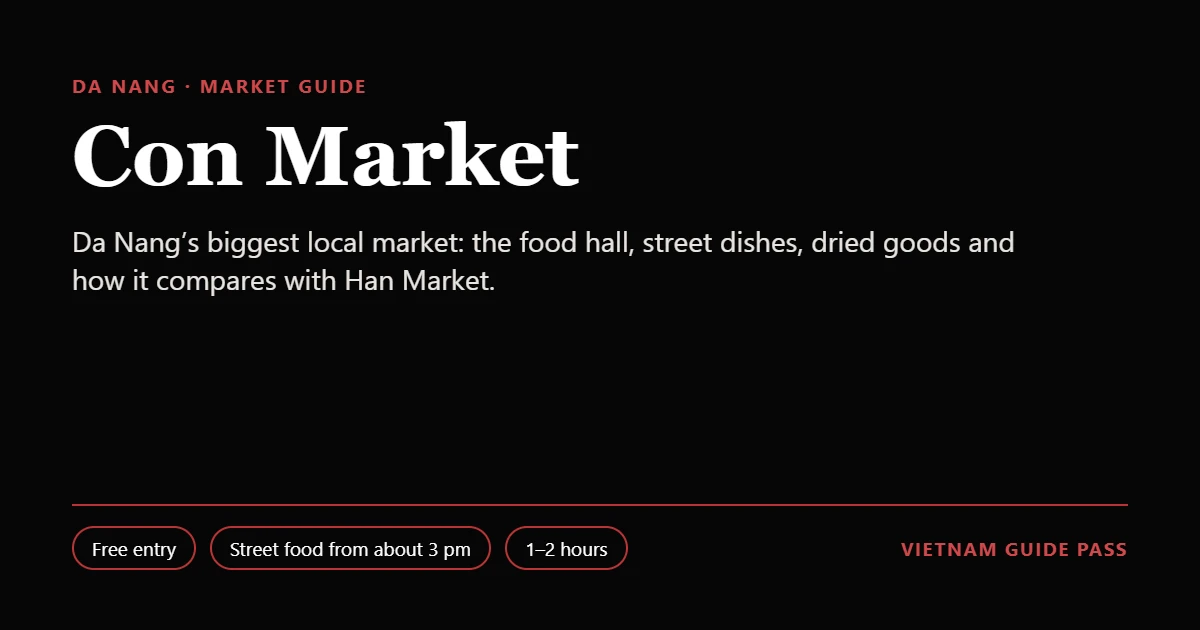
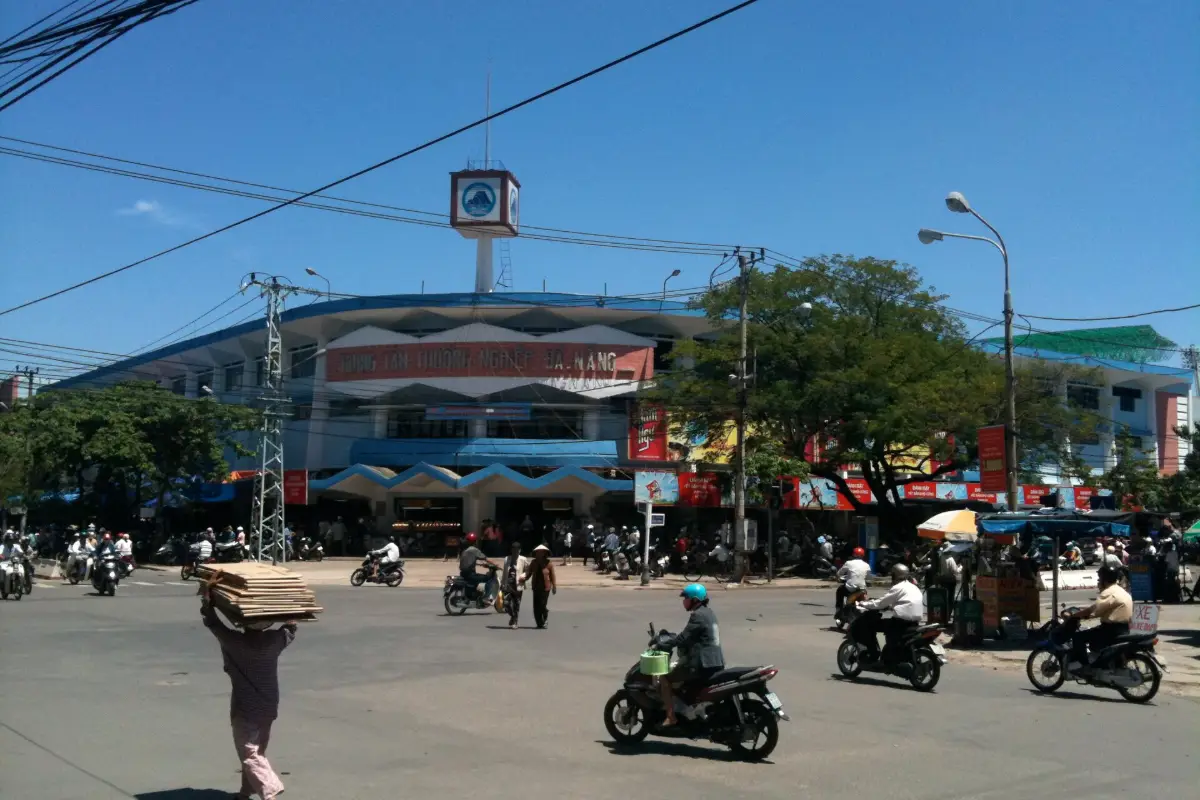
Con Market Da Nang (Chợ Cồn) is a busy local market at the corner of Hùng Vương and Ông Ích Khiêm streets. Most stalls run from about 6 or 7 am to 7 or 7:30 pm, although sources differ. Entry is free, and one to two hours is enough. The market suits food lovers best, with an indoor food hall by day and street stalls from mid-afternoon.
Opening hours and address of Con Market Da Nang
Con Market stands at the corner of Hùng Vương and Ông Ích Khiêm streets in central Da Nang. It is free to enter, and most stalls trade from early morning to early evening. Allow one to two hours. Published opening hours differ between sources, so treat the times below as a guide rather than a fixed schedule.
| Detail | Information |
|---|---|
| Address | Corner of Hùng Vương and Ông Ích Khiêm streets, Hải Châu, Da Nang. Often listed as 290 Hùng Vương or 269 Ông Ích Khiêm. Search “Chợ Cồn” on your map app. |
| General opening hours | Most stalls roughly 6–7 am to 7–7:30 pm. Individual stalls set their own hours. |
| Indoor food hall | About 7 am to 3 pm |
| Outdoor street food | From about 3 pm |
| Entry | Free |
| Time needed | 1–2 hours |
| Getting there | Grab or taxi is the simplest option. Ask to be dropped at the street corner. |
Information checked November 2026. Da Nang’s official tourism site lists 290 Hùng Vương and 7:00–19:30 on one page, but 269 Ông Ích Khiêm and 9:00–18:00 on another. Hotel and travel guides mostly give about 6–7 am to 7–7:30 pm.
Is Con Market Da Nang worth visiting?
Yes, if you want to see a working local market and eat well at low cost. Con Market serves residents first, and its food is the main draw for visitors. It is not a souvenir market, as the travel guide LocalVietnam points out. Báo Văn hóa lists it among Da Nang’s four Grade 1 markets, alongside Han Market.
It suits travellers who like local food and do not mind crowds and noise. It suits less well if you want a quiet browse or a wide choice of gifts. The tips further down cover practical points such as cash and language.
When Con Market began and how it changed
Con Market began in the 1940s on a raised area of sandy ground, which gave it its name. It became a formal market in 1958 and was rebuilt in 1985. Today it covers about 14,000 square metres, according to the national newspaper Nhân Dân.
Tuổi Trẻ gives 1940 as the year the market was founded. The authorities built the formal market in 1958 to ease pressure on Han Market. It was rebuilt in 100 days and reopened in late March 1985: Nhân Dân gives 29 March, while the city’s tourism site gives 27 March. The same Nhân Dân report counts more than 2,000 businesses and over 10,000 visitors a day.
What to eat at Con Market Da Nang
Con Market’s food is mainly central Vietnamese: noodles, rice cakes, grilled pork and sweet desserts. The indoor food hall runs from morning to mid-afternoon, and outdoor street food starts from about 3 pm. Most dishes cost roughly 15,000–50,000 VND (about US$0.60–2), according to Da Nang’s official tourism site. Tuổi Trẻ gives about 30,000–50,000 VND (about US$1.20–2) per dish.
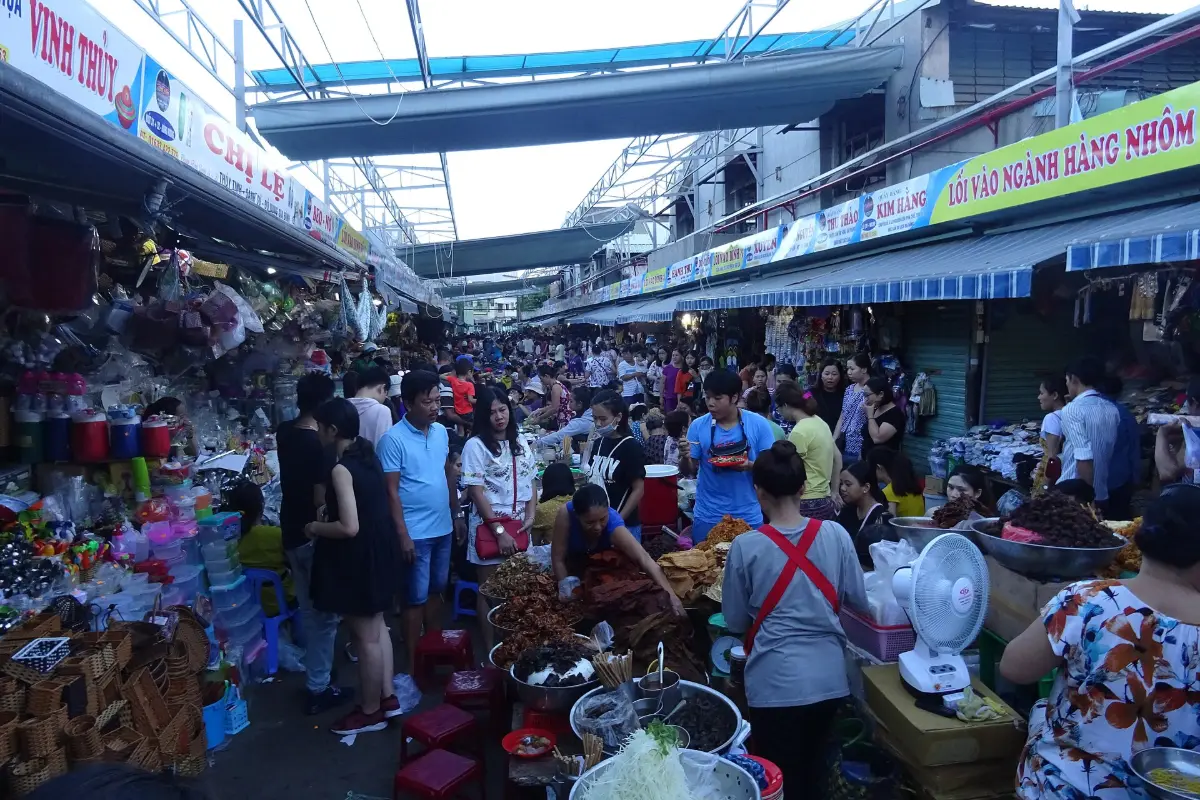
Dishes named in these sources include:
- Mì Quảng: wide rice noodles with a small amount of broth, usually topped with pork, shrimp or chicken.
- Bánh bèo: small steamed rice cakes served in little dishes with toppings.
- Bánh xèo: a crisp rice-flour pancake with pork and shrimp, eaten wrapped in herbs.
- Bún mắm nêm: rice vermicelli served with a fermented anchovy sauce.
- Nem lụi: grilled pork skewers, usually eaten with herbs and rice paper.
- Bánh tráng cuốn thịt heo: rice paper rolls with boiled pork, dipped in mắm nêm.
- Bánh canh: a thick noodle soup.
- Bánh bột lọc: small tapioca dumplings, often filled with shrimp and pork.
- Ốc: snails, cooked in several styles.
- Chè: sweet dessert soups, including banana chè.
- Kem bơ: mashed or blended avocado topped with ice cream, often coconut.
Menu details and portions vary by stall. If you do not read Vietnamese, point at what you want and ask the price before you order. Prices in private travel blogs vary widely, so use the range above only as a general guide.
What to buy at Con Market
Dried seafood and fermented sauces are the main buys for visitors at Con Market, and the market also has fabric and clothing stalls. Tuổi Trẻ mentions dried squid, dried beef and braised fish. Da Nang’s tourism site, on its Vietnamese-language page, adds dried shrimp, dried fish and fermented sauces (mắm).
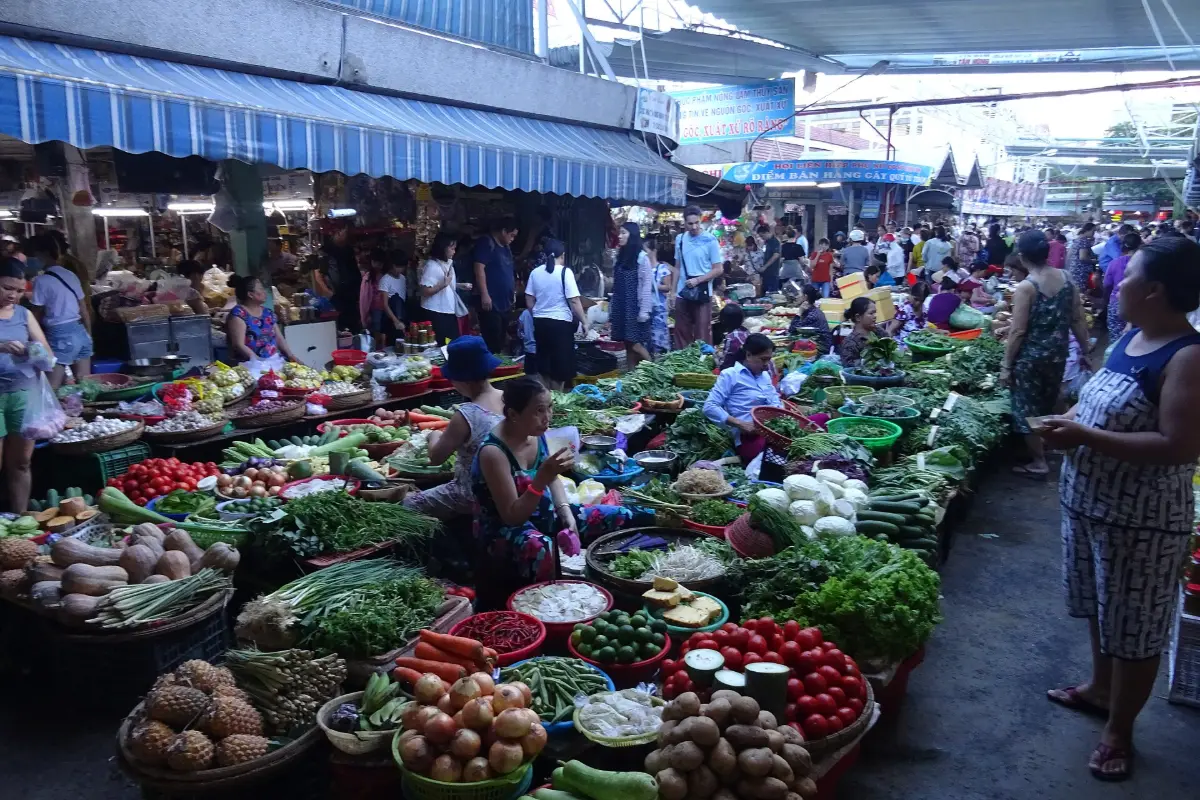
Common items include:
- Dried squid, shrimp and fish
- Braised fish (cá rim) and dried beef (bò khô)
- Fermented sauces (mắm), such as mắm nêm, the fermented anchovy sauce used with pork rolls
- Fabric and clothing stalls
- Fresh produce, meat and seafood, which one source suggests are best bought in the morning
If you plan to take food home, read the last question in the FAQ before you buy.
Con Market vs Han Market: which should you visit?
Choose Con Market for local food and everyday shopping. Choose Han Market for gifts, tailoring and an easier first visit near the river. The two markets are about 1 km apart along Hùng Vương street, roughly a 12–15 minute walk, so you can visit both in one outing.
| Feature | Con Market | Han Market |
|---|---|---|
| Atmosphere | Local, busy and noisy | More oriented to visitors |
| Best for | Eating, dried goods, everyday items | Gifts, fabric and tailoring |
| Prices | Generally lower | Generally higher |
| Location | Corner of Hùng Vương and Ông Ích Khiêm streets | 119 Trần Phú, near the Han River |
These comparisons come from hotel and travel guides, not an official ranking. For floors, tailors and shopping tips at the other market, see our Han Market Da Nang guide.
Tips for visiting Con Market Da Nang
Bring small notes in Vietnamese dong, wear closed shoes and try to arrive outside the busiest hours. Food and many dried goods are sold at posted prices, while mild bargaining is common for clothing. A few simple habits make the visit easier for you and for the sellers.
- Cash: stalls generally take cash, and small notes make payment easier.
- Prices: ask the price of dried goods per weight before the seller packs them.
- Crowds: the market is busiest around midday and at weekends. The outdoor food area fills up from mid-afternoon.
- Footing: floors can be wet, so closed shoes are safer than sandals.
- Belongings: keep bags zipped and in front of you in crowded aisles.
- Photos: ask permission before photographing sellers or their stalls.
- Language: English is limited at many stalls. A translation app or numbers typed on your phone help.
Listening to Con Market with an audio guide
The Da Nang – Hoi An Guide Pass includes three audio stops at Con Market, so you can hear the market’s background as you walk. The same pass covers 21 Da Nang and Hoi An sites, with audio in English, Vietnamese, Chinese and Korean. It runs in your phone browser, with no app to download.
FAQ
In Chợ Cồn, the word cồn means a mound or sandbank, and chợ means market. Locals call it Chợ Cồn, and English-language travel guides usually call it Con Market.
Yes. After the 1985 rebuild, the market was named Trung tâm Thương nghiệp Đà Nẵng, or Da Nang Commercial Centre. It took back the name Chợ Cồn in 2012, according to Nhân Dân.
It depends on your country. Many countries restrict meat and dried seafood, and fish sauce falls under liquid limits in carry-on bags. Check your country’s import rules and your airline’s baggage policy before you buy, and declare food items on arrival forms where required.
Plan your Da Nang market day with the Da Nang – Hoi An Guide Pass
The Da Nang – Hoi An Guide Pass starts from 149,000 VND (about US$6) for one day, including VAT. You can choose one to four days. The pass is an audio guide and does not include entry tickets. Read the common questions about the pass before you buy.