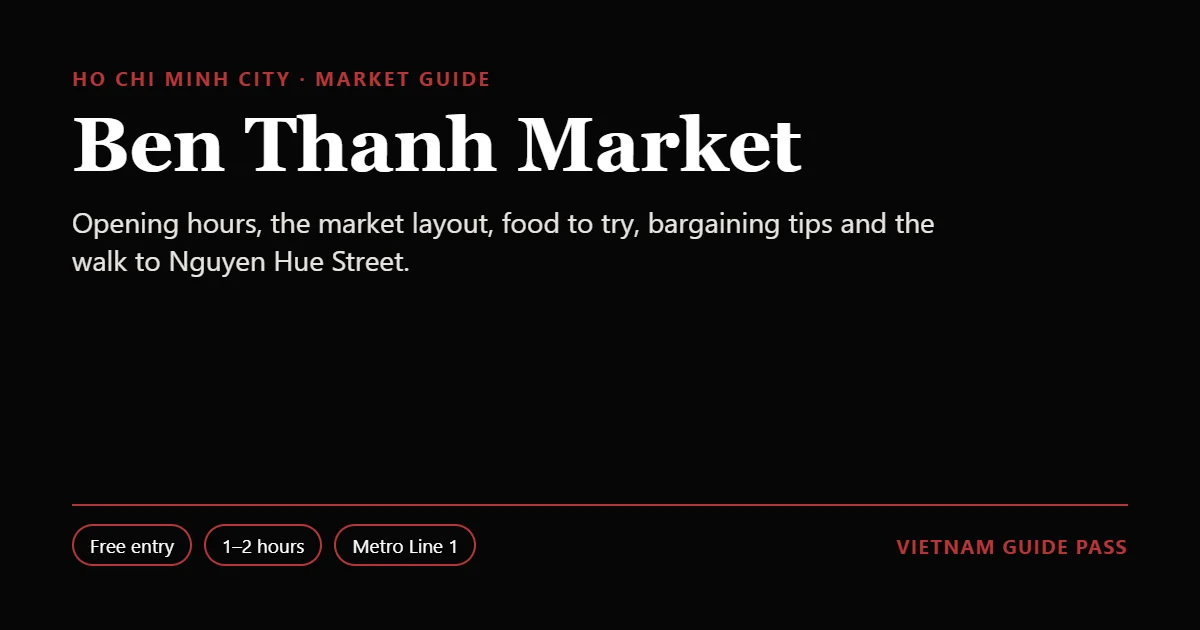
Ben Thanh Market opens from early morning and does not close as a whole, though each stall sets its own hours. The day moves from fresh produce at dawn, to browsing in the hall by day, to cooked food after dark. Entry is free, and one to two hours is a reasonable estimate for a first visit.
Ben Thanh Market is a covered market in central Ho Chi Minh City. Visitors come for coffee, dried fruit, spices, souvenirs and quick meals under one roof. It suits first-time visitors who want an easy introduction to Vietnamese market life.
This guide covers hours, history, layout, food, bargaining, safety and a walking route to nearby sights.
Ben Thanh Market opening hours and visitor info
Ben Thanh Market opening hours follow a daily rhythm rather than one fixed schedule. The market is active from early morning, and individual stalls set their own hours. Stalls inside the hall and food stalls outside keep different hours, so the time you arrive decides what you find open. The table gives the practical details.
| Detail | Information |
|---|---|
| Address | Le Loi Street, Ben Thanh Ward, Ho Chi Minh City |
| Opening hours | From early morning; each stall sets its own hours |
| Entry | Free |
| Toilets | Inside the market, for a small fee |
| Getting there | Metro Line 1 to Ben Thanh station, or a taxi or ride-hailing car (see the metro section below) |
| Time needed | 1–2 hours (our estimate) |
| Holidays | Trade can change on public holidays |
Information checked November 2026. Opening pattern confirmed locally. The market has no official website that publishes its hours.
Websites list fixed hours for the market, but they disagree with each other, and in practice each stall keeps its own hours. If you need a particular stall late in the day, ask the stallholder in advance.
How do you get to Ben Thanh Market by metro?
Metro Line 1 is the simplest way to reach Ben Thanh Market from the east of the city. The line runs between Ben Thanh and Suoi Tien, and Ben Thanh station sits underground beside the market. It opened to passengers on 22 December 2024.
Single-journey fares were reported at 7,000 to 20,000 VND in early 2026, depending on distance. Paying without cash lowers each fare slightly. Reported day and three-day tickets cost 40,000 VND and 90,000 VND.
Sources give different operating hours, and the schedule has changed since opening. Check the times at the station before you plan an early or late trip.
Taxis and ride-hailing cars can also drop you at the gates. Ask the driver for the south gate if you want to start under the clock tower.
How old is Ben Thanh Market? A short history
The current building of Ben Thanh Market was completed in 1914, but the market itself is older. Sources disagree on when the first market began. One places it in the early 17th century and another in the early 19th century, and both date it before the French colonial period.
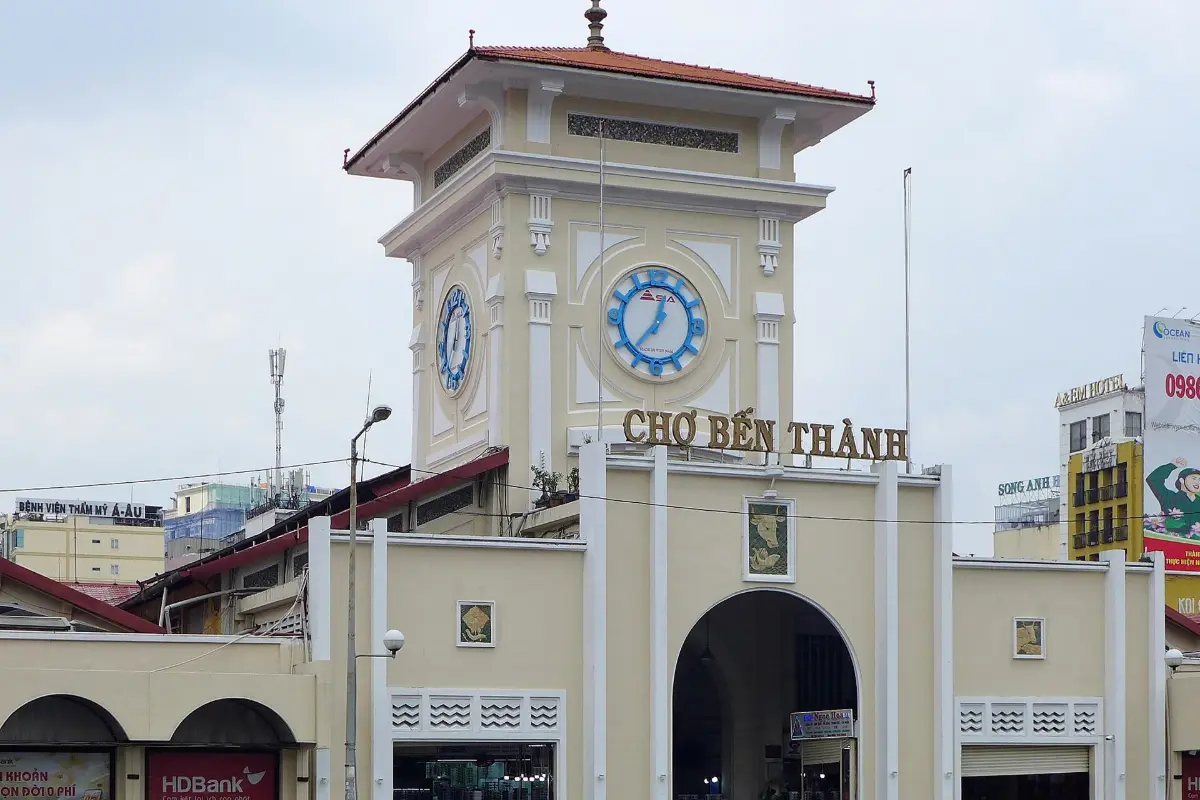
An earlier market near the Saigon River burned down in 1870. Work on a new building on the present site began in 1912, and the old site became known as Cho Cu, the Old Market.
A Voice of Vietnam report dates the official opening to March 1914. The clock tower over the south gate still stands.
The market was restored in 1985, when the roof and stalls were renewed. Wikipedia records a further renovation in 2022.
The square in front of the market is a separate matter. A renovation plan was approved, and reports on its schedule differ, so check what you find on site. The 2025 plan described more greenery, new paving and restored statues of Tran Nguyen Han and Quach Thi Trang.
When is the best time to visit? The market hour by hour
The best time depends on what you want. Early morning suits local trade, the middle of the day suits browsing, and the evening suits eating. This is a general description of the market’s rhythm, not a record of one trip, and conditions change with the season and the weather.
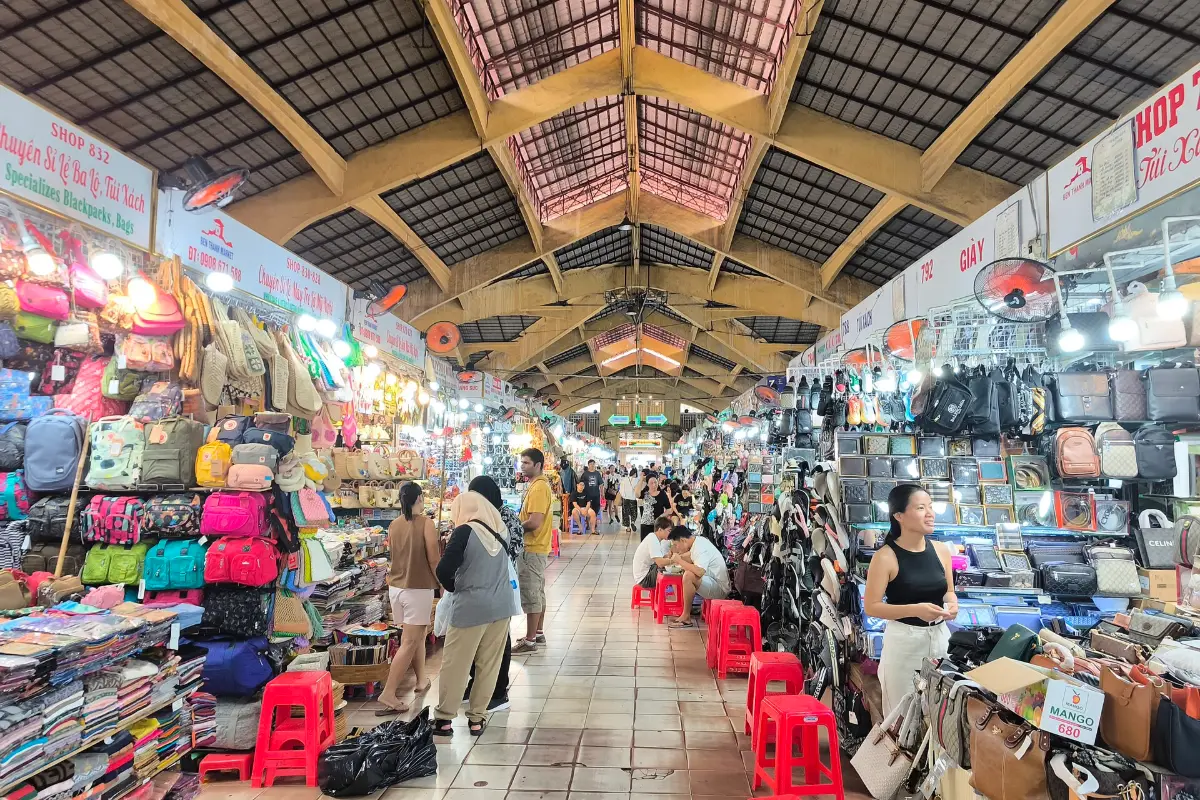
Early morning. Early morning is when the fresh produce at the back of the hall is busiest, and local shoppers buy for the day. Go at this time if you want to see the market as a working place for local trade.
Mid-morning. By mid-morning the stalls selling coffee, dried fruit and spices in the middle of the hall are open. Go at this time if you want to browse with the full choice of stalls open.
Midday. Midday can be warm inside the covered hall. Go at this time if you want a cold drink and a seat at the food stalls, and you do not mind the heat.
Afternoon. In the afternoon you can browse at a slower pace. Go at this time if you want a calmer look at the stalls and time to talk with the people behind them.
Evening. In the evening the action moves to the food stalls and the streets beside the hall. Go at this time if you want to eat and watch the city after dark. The evening section below explains what to expect.
Ben Thanh Market map and layout
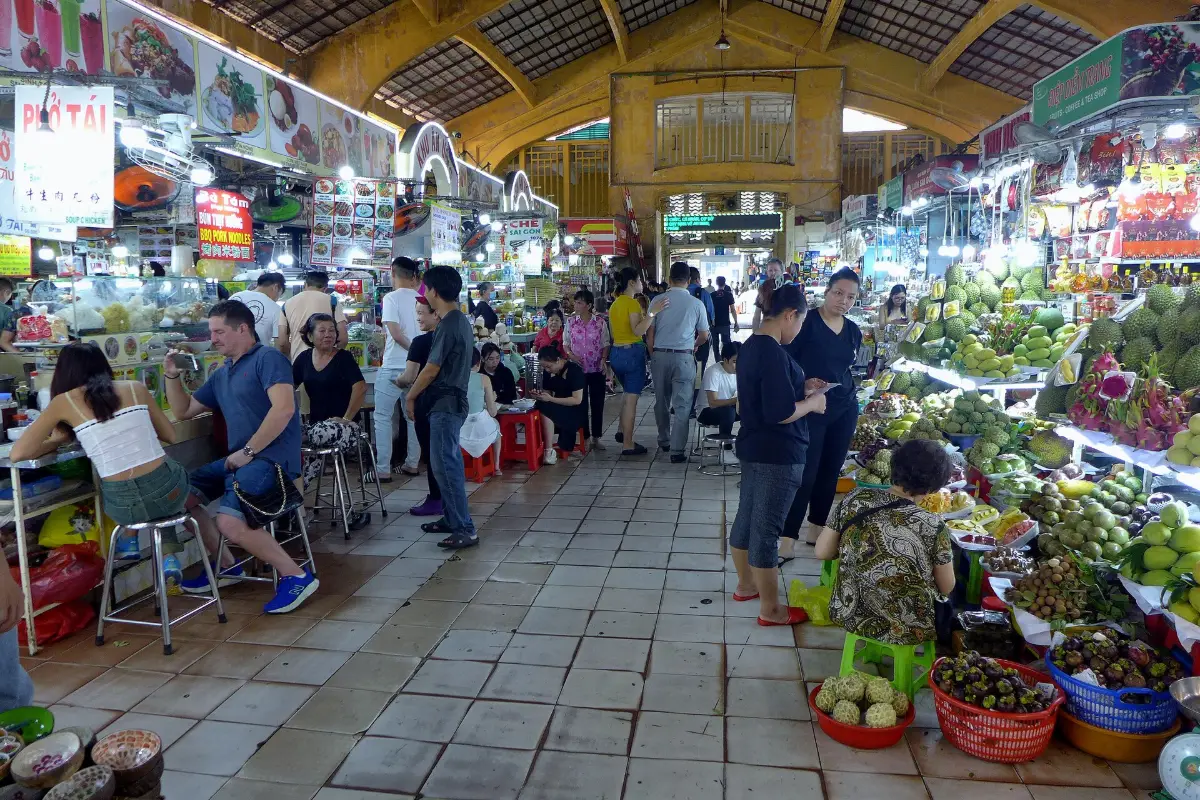
Ben Thanh Market has three broad zones inside a hall with four main gates. The outer ring holds clothes, bags, shoes and souvenirs. The middle holds dry goods such as coffee, tea, spices, dried fruit and coconut candy. Fresh produce sits at the back, and food stalls line the edges.
The south gate faces Le Loi Street and carries the clock tower. The north gate opens onto Le Thanh Ton Street and the west gate onto Phan Chu Trinh Street. The east gate opens onto Phan Boi Chau Street.
Commonly reported figures put the market at about 13,000 m² with around 1,500 stalls. Treat both numbers as approximate. Food stalls are most numerous along the south and east edges, according to one guide.
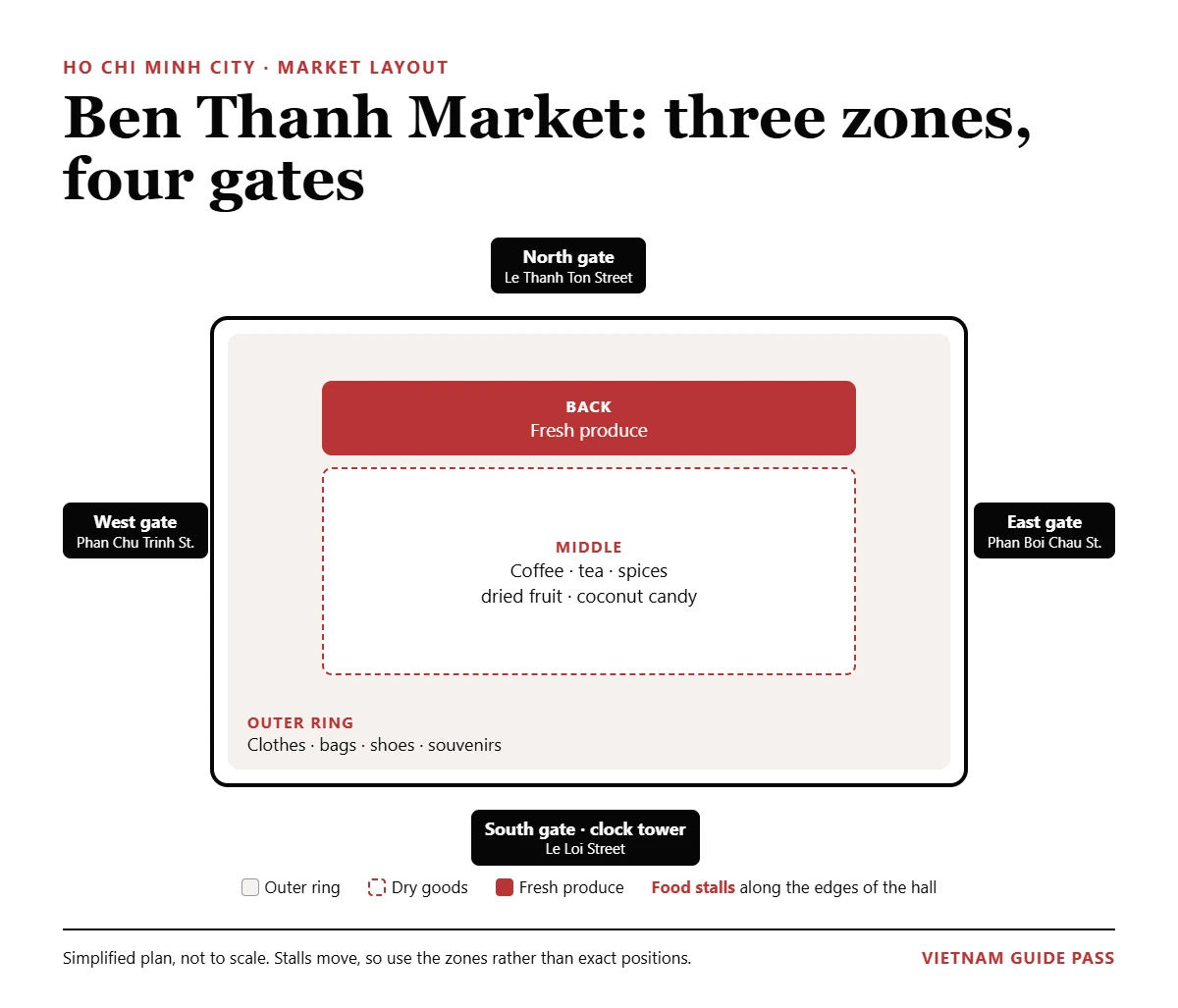
Sources disagree on which goods sit near each gate, so use the zones rather than the gates to find what you want.
A simple route works well. Enter by the south gate and walk the outer ring for clothes and souvenirs. Cut through the middle for coffee and dry goods. Finish at the food stalls along the edge, then leave by the gate nearest your next stop.
What to buy and how to check quality
Popular purchases are Vietnamese coffee, nuts and dried fruit, pepper and spices, coconut candy, sesame rice crackers, bags and wallets, and ao dai. Dry packaged goods travel best, while clothing and bags need a closer look. Check each item before you pay, using the steps below.
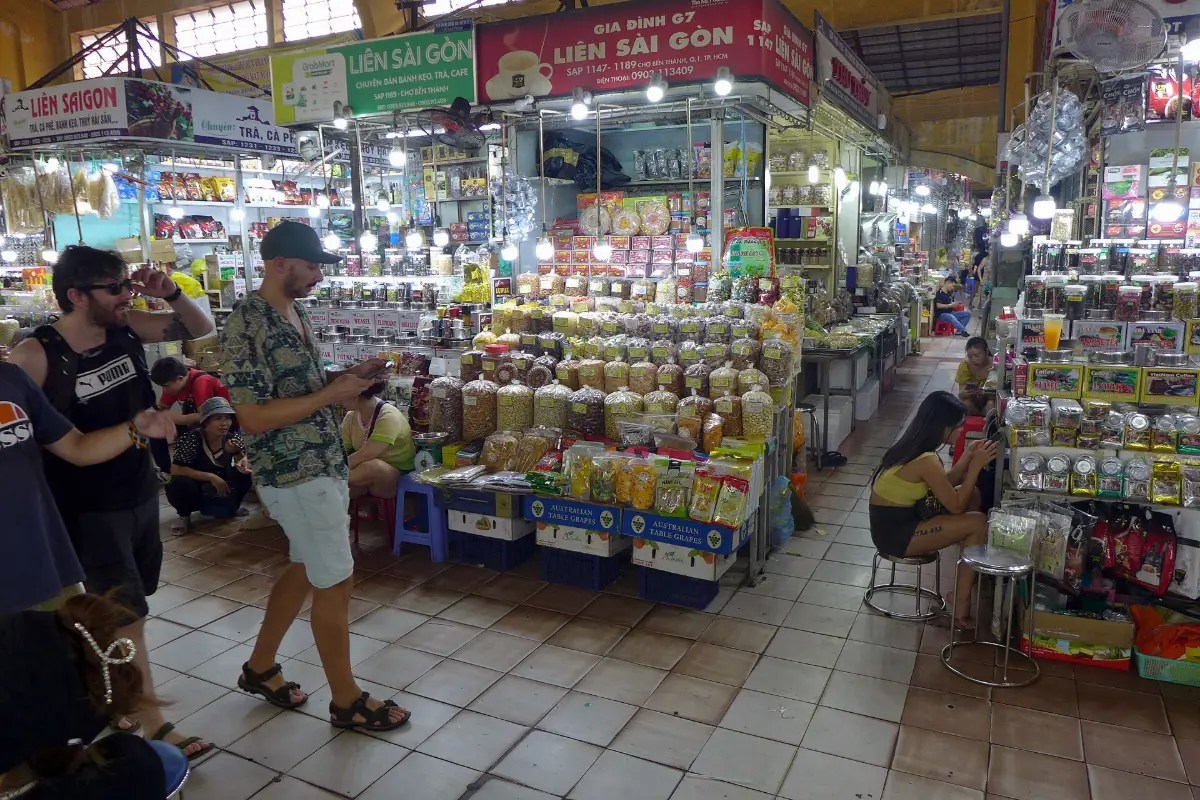
Notes on the main items:
- Coffee, sold ground or as beans, usually in sealed bags. Much Vietnamese coffee is robusta, which tastes stronger and more bitter than arabica. Stalls often sell blends for the phin, the small metal filter used at home.
- Pepper and spices, including Phu Quoc pepper.
- Coconut candy, a small sweet that packs flat.
- Sesame rice crackers (banh trang me), light and easy to carry.
- Ao dai, the traditional Vietnamese long dress.
How to check quality:
- Dry goods: smell or taste before you buy, where the vendor allows it.
- Packaged goods: read the label, check the seal and confirm the weight.
- Clothing: look at the seams, the zips and the fabric.
- Ao dai: ask exactly what the quoted price includes.
- Dates: check the printed date on packaged food.
Quality varies between stalls, even for the same product. A few minutes of checking at the stall costs less than a poor purchase you only notice at your hotel. Ground coffee should smell rich, and dried fruit should look and smell fresh rather than flat or damp.
Ben Thanh Market food: dishes and drinks to try
Ben Thanh Market food covers the Vietnamese classics: noodle soups such as pho and bun rieu, broken rice, grilled pork with vermicelli and fresh spring rolls. Popular drinks include iced coffee and sugarcane juice. Travel guides list the same core dishes again and again, and the groups below help you choose.
- Soups and noodles: pho, banh canh cua (crab noodle soup), bun rieu (crab and tomato noodle soup) and banh cuon (steamed rice rolls).
- Light bites: goi cuon (fresh spring rolls) and banh mi (filled baguette).
- Rice and grilled dishes: com tam (broken rice), bun thit nuong (grilled pork with vermicelli) and banh xeo (crisp savoury pancake).
- Sweets and drinks: che (sweet dessert soup), ca phe sua da (iced coffee with condensed milk), nuoc mia (sugarcane juice) and nuoc dua (coconut water).
Choose a stall with steady customers and a menu that shows prices per dish. If you do not read Vietnamese, point at the dish or ask to see the menu. Order one dish first, so you can judge the portion before you add more.
Seafood needs more care. One travel article describes small crabs billed at a very high price. Ask the price before you order, and ask again for the total if the stall weighs or counts the portion. A short check at the start avoids an argument at the end.
How do you bargain at Ben Thanh Market?
Stallholders often quote visitors a high first price, so bargaining is normal at stalls selling clothes, bags and souvenirs. Food and fresh produce usually have fixed prices. Sources suggest opening at 40 to 50 percent of the asking price, or about half, while one author settles at a third to a quarter. Treat no single ratio as the standard.
Follow these five steps:
- Compare the same item at a few stalls before you start.
- Keep your manner light, because a smile helps more than pressure. Let the seller quote first, then answer with a clearly lower figure.
- Walk away politely if the price does not suit you.
- Agree the final price before the item is wrapped. Say the number aloud so there is no confusion.
- Carry small notes so you can pay the exact amount.
The aim is a price that feels fair to both sides, not the lowest number. Bargaining is a conversation, not a contest.
What happens around the market in the evening?
In the evening, food stalls and open-air grills operate on the streets beside the market, notably Phan Boi Chau and Phan Chu Trinh. Think of the area as a dinner district rather than a formal night market.
Sources disagree about a managed night market. Several blogs describe one with fixed evening hours. Another source says the organised night market stopped after COVID-19, leaving only roadside food stalls and grills.
Check what is open when you arrive, because some stalls start late and others close early. A quick walk along both streets shows the choice. Sources mention grilled food, beer and seafood along both streets.
Is Ben Thanh Market safe? Looking after your belongings
Ben Thanh Market is a busy public place, so take the usual precautions for crowded areas. Keep your phone in a zipped bag in front of you, and take it out only when you need it, away from the kerb. Carry only the cash you expect to need.
- Keep bags closed and backpacks on your front at the gates and in narrow aisles.
- Count your change at every stall.
- Photograph menus and price tags so you can compare them with the bill.
- If someone presses you to buy, decline politely and keep walking.
- Keep your wallet and phone in separate pockets or compartments.
- Keep your passport in your hotel safe when you can, and carry a photo or copy of the main page.
- Step to the edge of an aisle, not the middle, when you check a map or a message.
These habits take little effort. They let you focus on the stalls rather than on your pockets.
From Ben Thanh Market to Nguyen Hue Walking Street
Nguyen Hue Walking Street lies about 10 to 15 minutes on foot east of the market, along Le Loi Street. From the market’s south gate, turn east and follow Le Loi. It is a busy road, so take care at every crossing. The walking street is free to enter.
The street is more than 670 m long and about 64 m wide. Under a rule in force from 1 March 2019, the street became completely off-limits to vehicles on Saturday and Sunday evenings, from 19:00 to 23:00. Rules can change, so check the current arrangement when you arrive.
At that width the boulevard has room to stroll. Late afternoon gives you daylight to see it, and the evening adds lights and more people.
A half-day route starting at Ben Thanh Market
A half-day route links Ben Thanh Market, Nguyen Hue Walking Street, the Saigon Central Post Office and Saigon Notre-Dame Basilica. It follows a line of sights in the city centre, mostly on foot. Start at the market, and allow time to stop along the way.
- Ben Thanh Market: begin with the hall and the food stalls.
- Nguyen Hue Walking Street: walk the length of the boulevard.
- Saigon Central Post Office: built from 1886 to 1891 to a design by the architect Alfred Foulhoux, and often wrongly credited to Gustave Eiffel.
- Saigon Notre-Dame Basilica: next to the post office, on Paris Commune Square. The basilica is under a long restoration expected to run until at least 2027, so expect scaffolding and check access on site.
Opening hours differ at each stop, so check them on site, and carry water and a hat for the daytime sun. Keep the route flexible and drop a stop if time runs short. To return, take a taxi or a ride-hailing car, or walk back to Ben Thanh station.
If you would rather spend part of the day indoors, the War Remnants Museum is about 15 minutes on foot from the market. The War Remnants Museum guide covers its hours and rooms, and the guide to museums in Ho Chi Minh City lists ten more.
FAQ
By the common explanation, “Ben” refers to the river wharf on the Ben Nghe waterway. “Thanh” refers to the Gia Dinh citadel. Sources describe this as a popular explanation rather than a settled fact, and the market kept its name when its new building opened in 1914.
Yes. Ben Thanh Market is one of the 20 sites covered by the Saigon Guide Pass, an audio guide for your phone. What it includes, and its price, are at the end of this page.
Yes, for a short visit. It lets you see a working central market, buy coffee or dry goods, and eat a quick meal. If you want low prices or a quiet atmosphere, a neighbourhood market may suit you better.
Plan more of your Ho Chi Minh City trip
The pages below help you add more sites and practical details to your plan. They cover the Cu Chi Tunnels, the War Remnants Museum, the city sites in the pass, common questions and the main places to visit.
- Cu Chi Tunnels visitor guide
- War Remnants Museum: what to see, opening hours and tips
- Independence Palace: tickets, hours and what to see
- All 20 Ho Chi Minh City sites in the Saigon Guide Pass
- Vietnam Guide Pass frequently asked questions
- The top sights to see in Ho Chi Minh City
Saigon Guide Pass, from Vietnam Guide Pass, is a digital audio guide to 20 sites in Ho Chi Minh City. The sites include the War Remnants Museum, Independence Palace and the Cu Chi Tunnels. It runs in your phone browser with no app and no account, and you need internet only to activate and download before listening offline. Languages are English, Vietnamese and Chinese, and the pass does not include entry tickets.
Get the Saigon Guide Pass, from 149,000 VND (VAT included, 1-day pass)