The Cu Chi Tunnels are a 250 km network of hand-dug wartime tunnels about 50–70 km northwest of central Ho Chi Minh City. Most visitors spend half a day there: around 1.5–2 hours each way by road, plus 1.5–2 hours on site. You can visit two sites, Ben Dinh (closer, busier) and Ben Duoc (further, quieter), on a group tour, by Grab, by public bus, or by speedboat along the Saigon River.
This guide covers opening hours and tickets, how to choose between the two sites, every way to get there with time and cost, and a simple half-day plan.
Quick facts
- What: a network of around 250 km of hand-dug tunnels used as a base and shelter during the wars against France and the United States.
- Where: Cu Chi, on the northwest edge of Ho Chi Minh City, 50–70 km from District 1.
- Sites to visit: Ben Dinh (closer, busier) and Ben Duoc (further, quieter).
- Time needed: half a day, including 1.5–2 hours on site.
- Open: daily, 7:00 AM – 5:00 PM.
- Getting there: group tour, Grab or private car, public bus, or speedboat.
- Audio guide: available for both sites with the Saigon Guide Pass, in English, Vietnamese and Chinese.
Opening hours, tickets and visitor info
| Opening hours | 7:00 AM – 5:00 PM, daily |
| Tickets | Bought at the gate on arrival, cash recommended. Each site sells its own ticket, and the current prices are posted at the counter. |
| Location | Cu Chi, on the northwest edge of Ho Chi Minh City. Search “Ben Dinh Cu Chi Tunnels” or “Ben Duoc Cu Chi Tunnels” in Grab or Google Maps. |
| Distance from District 1 | Ben Dinh ≈ 50 km · Ben Duoc ≈ 70 km |
| Time on site | 1.5–2 hours |
| Best time to go | Arrive at opening (7–8 AM): cooler, fewer tour groups. Dry season December–April. |
| Good to know | Tunnel sections are narrow and hot; skip the crawl if you are claustrophobic or have limited mobility. Wear clothes you don’t mind getting dirty, bring water and insect repellent. |
| Audio guide | Covers both Ben Dinh and Ben Duoc; included in the Saigon Guide Pass (English, Vietnamese, Chinese) |
What are the Cu Chi Tunnels?
The Cu Chi Tunnels are an underground network that local fighters and villagers dug by hand, mostly with hoes and baskets, to hide, live and fight beneath the countryside northwest of Saigon. Digging began in the late 1940s during the resistance against French rule, and the network was greatly expanded in the 1960s during the war with the United States.
At its peak, the network stretched for roughly 250 km, linking villages, rivers and command posts. The area sat inside what American forces called the “Iron Triangle”, only a short distance from the capital of South Vietnam. From here, fighters could move unseen, store weapons and launch attacks, including during the 1968 Tet Offensive on Saigon.
The land above was bombed, burned and sprayed with defoliants for years, and American and Australian soldiers known as “tunnel rats” were sent into the tunnels to search them. Much of the original network has collapsed, but two sections, at Ben Dinh and Ben Duoc, are preserved and open to visitors today.
How did people live inside the tunnels?
People lived underground for days or weeks at a time in hot, dark, narrow spaces, surfacing mainly at night. The tunnels were designed to keep them alive under constant bombing and searches.
Several levels deep
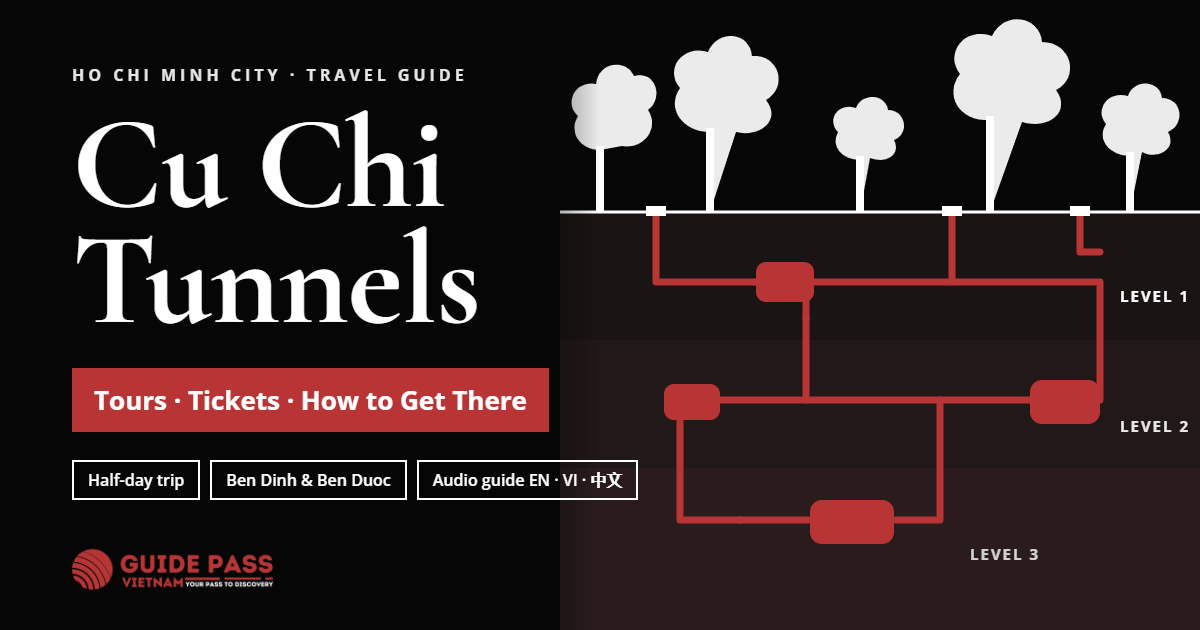
The network was built on up to three levels. The deepest parts, several metres down, offered shelter from bombs, while trapdoors and narrow passages slowed anyone trying to follow.
Smokeless kitchens
Cooking smoke would have given the tunnels away, so kitchens were fitted with long underground chimneys. The smoke was cooled and released far from the stove, where it drifted low over the ground like morning mist.
Hospitals, meeting rooms and wells
The network included field hospitals, meeting rooms, sleeping areas, wells for water and storage for food and weapons. Air came in through small vents, often hidden in termite mounds or tree roots.
Traps and hidden entrances
Entrances were tiny, covered with leaves and earth, and many were sized for a slim body. Around them, fighters set bamboo-spike pits and other traps made from scrap metal and wood.
Are the Cu Chi Tunnels worth visiting?
Yes, for most travelers the Cu Chi Tunnels are worth the half-day trip, and they rank among the top things to do in Ho Chi Minh City. They are one of the few places where you can physically experience how the war was lived, not just read about it, and the forest setting is very different from the city.
The visit is best if you are interested in history, curious about how ordinary people survived, and comfortable with heat, mud and a short crawl. It is less suited to travelers with very limited time in Ho Chi Minh City, people who dislike tight spaces and choose to skip the tunnels entirely, or anyone looking for a light, leisure outing.
To get the most out of it, pair it with the War Remnants Museum in the city: Cu Chi shows how people fought and survived, while the museum shows the wider cost of the war.
Ben Dinh or Ben Duoc: which Cu Chi Tunnels site?
Pick Ben Dinh if you want the quickest trip from the city; pick Ben Duoc if you want fewer crowds and the original tunnel area.
| Ben Dinh | Ben Duoc | |
|---|---|---|
| Distance from District 1 | ≈ 50 km, 1.5 hours | ≈ 70 km, about 2 hours |
| Crowds | Busy; most group tours stop here | Quieter, more space to walk |
| Tunnels | Sections widened for visitors | Closer to the original wartime base area |
| Extras | Shooting range, trap displays, war film | Ben Duoc Memorial Temple, forest trails |
| Best for | Short half-day trips, first-time visitors | History lovers, photographers, avoiding crowds |

Both sites tell the same story; the difference is mostly distance, crowds and atmosphere.
Using the audio guide? The Saigon Guide Pass audio guide covers both Ben Dinh and Ben Duoc, so you can pick whichever site suits your schedule.
How to get to Cu Chi Tunnels from Ho Chi Minh City
A group tour is the easiest option, Grab gives you the most freedom, and the public bus is the cheapest but takes most of the day.
| Option | Time each way | Budget | Good for |
|---|---|---|---|
| Group tour (bus) | 1.5–2 h | Mid-range; the entrance ticket is often included | First-timers who want a guide and no planning |
| Private car / Grab | 1.5–2 h | Depends on car size and waiting time; the Grab app shows the fare before you book | Families and small groups, flexible timing |
| Speedboat on the Saigon River | 1–1.5 h | The most expensive option, usually with lunch included | A scenic, faster trip |
| Public bus | 2–2.5 h | The cheapest option | Budget travelers with a full day |
By public bus: take a city bus from the centre to Cu Chi Bus Station, then a short local bus or Grab ride to Ben Dinh or Ben Duoc. Ask the driver or check Google Maps for the current route. Leave before 7:30 AM so you have enough time on site and can return before dark.
By Grab: book a car for the return trip with waiting time agreed upfront, or book a one-way ride and order another Grab back. Phone coverage is fine at both sites, but cars can take longer to arrive outside the city.
What you’ll see at the Cu Chi Tunnels
- The tunnels. Original passages were often no more than 80 cm high. Visitor sections are widened, but you will still crawl or crouch for 20–100 m. There are exits along the way if you need to come up.
- Hidden entrances and booby traps. Trapdoors barely wider than your shoulders, and bamboo-spike traps made from scrap metal and wood.
- Underground rooms. Kitchens with smoke-dispersal chimneys, meeting rooms and field hospitals where people lived for days without sunlight.
- Cassava with sesame salt. The simple food that kept fighters alive, usually offered to taste at the end of the visit.
- Shooting range. You can fire wartime rifles such as the AK-47 and M16, paid separately at the range. It is loud everywhere on site, so warn children in advance.
Cu Chi Tunnels tour vs self-guided
A tour saves planning, while going on your own gives you time to explore at your own pace and skip the crowds.
| Group tour | Self-guided (Grab or bus + audio guide) | |
|---|---|---|
| Planning | None | Book transport yourself |
| Pace | Fixed, often 1 hour on site | Your own; stay as long as you like |
| Crowds | Arrive with everyone else (around 10 AM) | Arrive at 7 AM before the tour buses |
| Explanation | Guide in English, quality varies | Audio guide in English, Vietnamese or Chinese |
| Combine with | Usually Mekong Delta or nothing | Anything you like, e.g. War Remnants Museum in the afternoon |
If you go self-guided, the Saigon Guide Pass gives you the Cu Chi audio guide plus 19 other Ho Chi Minh City attractions, from 149,000 VND.
How long do you need at Cu Chi?
Plan about half a day in total: 1.5–2 hours on site and 3–4 hours of travel there and back by road. A speedboat shortens the journey; the public bus makes it closer to a full day.
| Part of the visit | Time |
|---|---|
| Ticket, introduction and audio guide set-up | 15 minutes |
| Entrances, traps and above-ground displays | 30–45 minutes |
| Tunnel crawl and underground rooms | 20–30 minutes |
| Cassava tasting, rest stop, optional shooting range | 15–30 minutes |
If you like to read every sign and listen to every audio stop, allow up to 2.5 hours on site.
A simple half-day plan
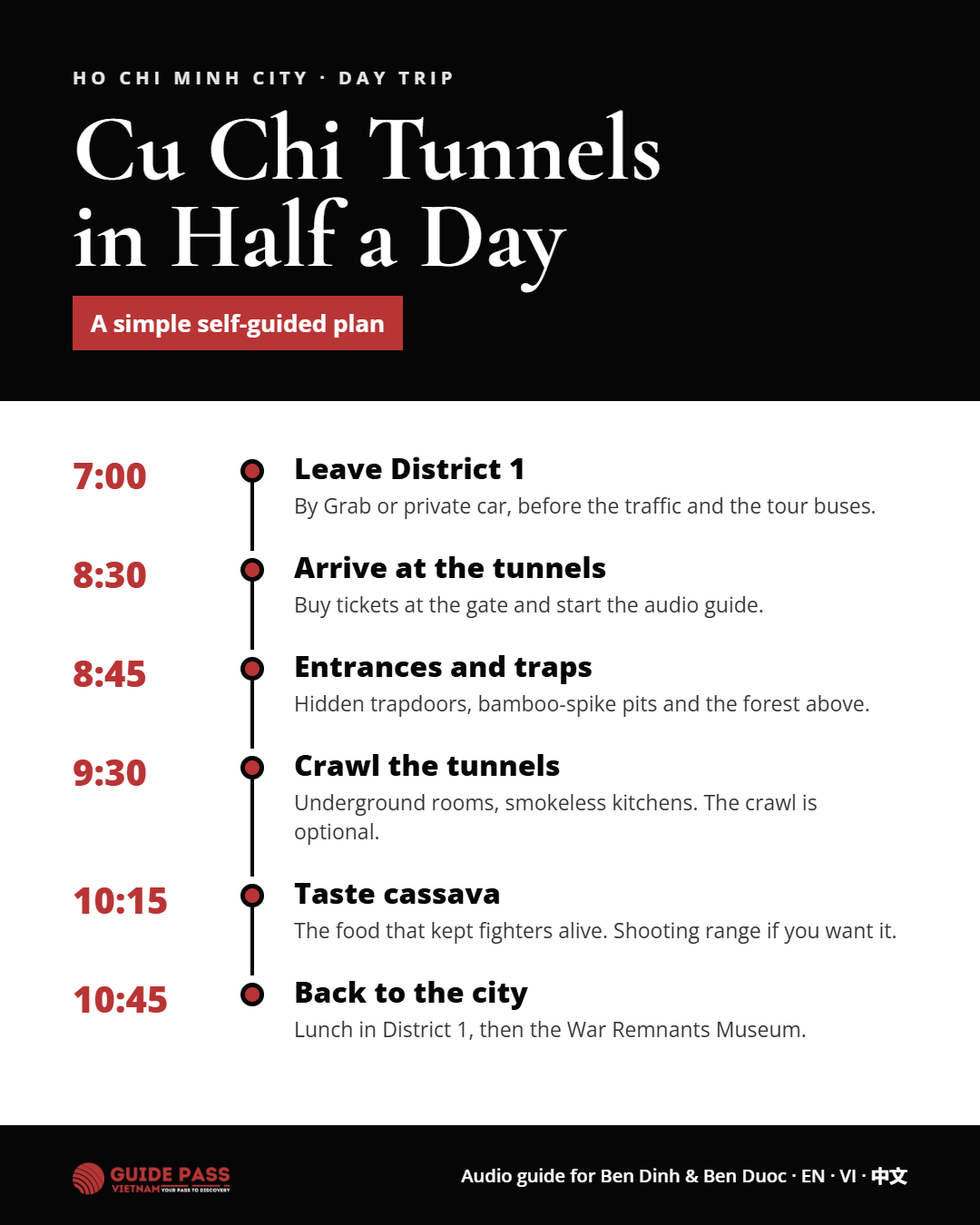
- 7:00 – Leave District 1 by Grab or private car.
- 8:30 – Arrive, buy tickets and start the audio guide.
- 8:45–10:15 – Entrances and traps, then the tunnel crawl and underground rooms.
- 10:15 – Taste cassava; shooting range if you want it.
- 10:45 – Head back to the city.
- 12:30 – Lunch in District 1, then the War Remnants Museum in the afternoon for the full story.
Can you combine Cu Chi with other sights?
Yes. The two most popular combinations are Cu Chi with the Mekong Delta, and Cu Chi with the War Remnants Museum. You can also pair it with any of the Ho Chi Minh City attractions covered by the audio guide.
- Cu Chi + War Remnants Museum (same day). Cu Chi in the morning, the museum in the afternoon. This gives you the full story in one day and is easy to do on your own with Grab and the audio guide.
- Cu Chi + Mekong Delta (full-day tour). Many tour operators sell this as one long day. It saves planning, but you spend a lot of time on the road and get less time at each place.
- Cu Chi + Cho Lon or District 1 evening. After a morning at the tunnels, an easy afternoon around Chinatown or an evening audio walk along Nguyen Hue Walking Street balances out the heavy history.
Try not to squeeze Cu Chi into the same day as a flight; traffic on the way back into the city can be slow.
When is the best time to visit?
The best time is early morning, on a weekday, in the dry season.
- Time of day: arrive when the gates open at 7:00. It is cooler, the paths are quieter, and you are ahead of most tour groups, which tend to arrive mid-morning.
- Season: the dry season, roughly December to April, has the most comfortable conditions. In the rainy season, roughly May to November, short heavy showers are common, paths get muddy and the tunnels feel more humid, but the site stays open and is less crowded.
- Days to avoid: weekends and Vietnamese public holidays, such as Tet (Lunar New Year) and 30 April, bring more domestic visitors.
Whatever the season, bring water and a hat: most of the visit is outdoors under the trees.
Is it safe? Advice for claustrophobia, children and older travelers
Yes, the Cu Chi Tunnels are safe to visit. The tunnel sections open to visitors have been widened and reinforced, staff guide groups through, and the crawl is always optional.
- If you feel claustrophobic: start with the shortest section and tell the staff before you go in. There are exits along the way, and you can see a tunnel entrance and an underground room without crawling at all.
- With children: most children enjoy the trapdoors and the forest. Explain beforehand that some displays show war and weapons, and that the shooting range is loud. Keep small children close on the paths.
- For older travelers or limited mobility: the forest paths are uneven, with roots and steps, and the tunnels require crouching or crawling. You can still enjoy the above-ground areas at a slower pace; ask your driver or guide to keep the walking short.
- In the heat: drink water before you feel thirsty and take breaks in the shade. The tunnels are warmer and more humid than the forest above.
What to wear and bring
Wear clothes you are happy to get dirty and shoes you can crouch in.
- Closed shoes with grip (paths can be slippery after rain)
- Light long trousers or shorts below the knee for crawling
- A dark or old T-shirt; red earth stains light colours
- Water, sunscreen, a hat and insect repellent
- Cash in small notes for tickets, drinks and the shooting range
- A charged phone and headphones if you are using the audio guide
- A small towel or wet wipes for after the crawl
Leave large bags in the car if you can; you will not want to carry them through the tunnels.
How to visit respectfully
Cu Chi is a place where many people died, and for many Vietnamese visitors it is a memorial as much as an attraction.
- Keep your voice down at the memorial areas and temple.
- Ask before photographing staff or other visitors, especially veterans.
- Treat the shooting range as optional; some visitors prefer to skip it.
- Stay on marked paths and do not climb on displays or bunkers.
Going early, listening to the stories and taking your time is the best way to understand what happened here.
Cu Chi Tunnels FAQ
How long do you need at the Cu Chi Tunnels? Plan 1.5–2 hours on site and about half a day in total, including travel from Ho Chi Minh City.
Can you visit the Cu Chi Tunnels without a tour? Yes. Take a Grab or private car (about 1.5–2 hours) or the public bus, buy tickets at the gate, and use an audio guide for the explanations.
Which is better, Ben Dinh or Ben Duoc? Ben Dinh is closer and easier for a short trip. Ben Duoc is further but quieter and closer to the original base area.
Is there an audio guide at the Cu Chi Tunnels? Yes. The Saigon Guide Pass includes a Cu Chi Tunnels audio guide for both Ben Dinh and Ben Duoc, in English, Vietnamese and Chinese that plays on your phone, with no app download.
Is the Cu Chi Tunnels visit suitable for children? Yes for most children. The tunnel crawl is optional, but the gunfire from the shooting range is loud across the site.
Do you need to book the Cu Chi Tunnels in advance? No. If you go on your own, you buy tickets at the gate on the day. Book ahead only if you want a group tour, a private car or a speedboat, especially in peak season.
Is the shooting range included in the ticket? No. The shooting range is optional and paid separately at the range. You can visit the tunnels without using it.
Can you visit the Cu Chi Tunnels in the rainy season? Yes. The site stays open all year. Go early, as showers are more common in the afternoon, and wear shoes with grip because the paths can be muddy.
Are there toilets and food at the Cu Chi Tunnels? Yes. Both sites have toilets, drinks and simple snacks, and you can taste the cassava that fighters ate during the war. For a full meal, most visitors eat after returning to the city.
Is the Cu Chi Tunnels visit wheelchair accessible? Only partly. The forest paths are uneven and the tunnels require crouching or crawling, so they are not accessible. Some above-ground displays can be seen with help.
Should I visit the Cu Chi Tunnels or the War Remnants Museum first? Either works, but many travelers prefer Cu Chi first. The tunnels show how people fought and survived; the War Remnants Museum then puts that experience into the wider story of the war.
Explore Cu Chi at your own pace
Hear the stories behind every trapdoor and tunnel on your phone. The Saigon Guide Pass covers the Cu Chi Tunnels and 19 more Ho Chi Minh City attractions, in English, Vietnamese and Chinese, from 149,000 VND.
Related: Things to do in Ho Chi Minh City · Ho Chi Minh City audio guide · Saigon Night Pass